Your fertilizer program feeds the plant. Biology decides how much of it gets there.
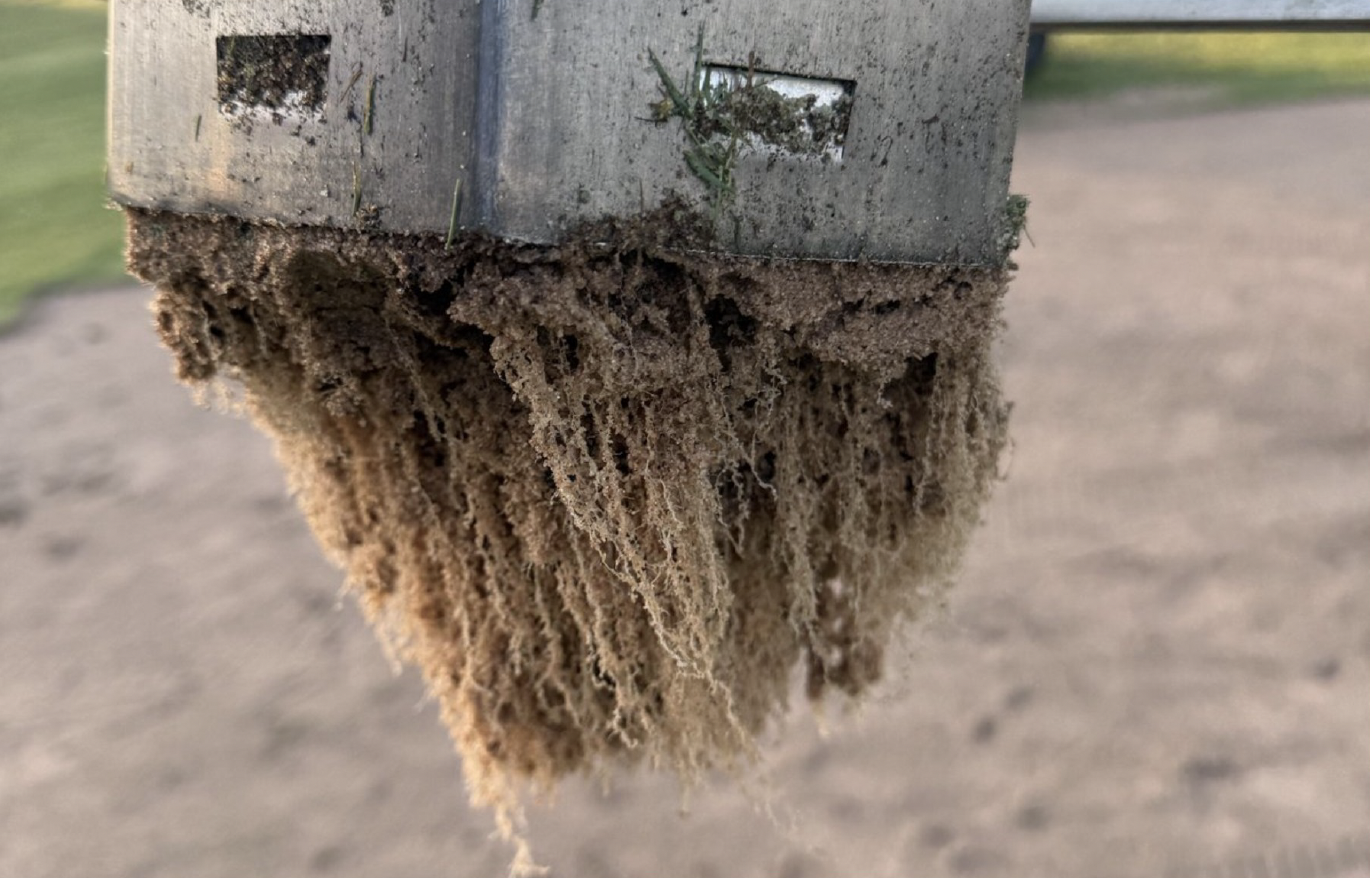
*Proven Results at Dornick Hills Golf & Country Club.
Most turf programs are built on chemistry: N-P-K, pH, CEC, the numbers on a soil test. Those numbers matter. But they only describe half of what is happening in the root zone. The other half is alive.
A single gram of healthy soil can hold hundreds of millions of bacteria, plus miles of fungal threads, protozoa and nematodes. Together they form a working system that decides how much of what you apply actually reaches the plant.
The root zone is a trading floor
Plants don't just take from the soil. They pay into it. Roots release sugars, amino acids and organic acids, called root exudates, into the thin layer of soil around them.
That isn't waste. It's payment. The exudates feed microbes clustered around the root, an area called the rhizosphere. In return, those microbes do jobs the plant can't do on its own.
Four jobs soil microbes do for turf
01
Unlock nutrients
Microbes free bound phosphorus and make iron available through compounds called siderophores.
03
Build soil structure
Sticky microbial compounds bind particles into aggregates, opening pore space for water, air and roots.
02
Recycle organic matter
Clippings, dead roots and thatch are broken down and returned as plant-available nutrients.
04
Help roots handle stress
A well-colonized root zone supports deeper rooting and better heat, drought and traffic tolerance.
Why turf soils often run short on biology
Golf greens and athletic fields are built for drainage and playability, not biology. Sand-based root zones start with little organic matter. Add compaction, heavy traffic, salt loads from some fertilizers and repeated fungicide applications, and the root zone ends up with far fewer workers than a native soil.
The plant still gets fed, but the program does more of the work and the soil does less. That usually shows up as more inputs for the same result.
Inoculants supply the workforce. Biostimulants keep it fed.
Inoculants and biostimulants: two different tools
Microbial inoculants add living, beneficial microbes back to the root zone, often species of Bacillus and Pseudomonas selected for nutrient cycling and root colonization. Biostimulants feed and support the biology and the plant: humic and fulvic acids, sea kelp and protein hydrolysates.
Where to start
You don't need to rebuild your program. Add biology to what you already do, on the areas that give you the most trouble, and watch rooting, color hold and recovery over a season. Biology is not a quick fix. It's a system you build, and it compounds.
Pull a soil probe on your best and worst area and compare the roots side by side: depth, color and how much soil clings to them. Biologically active roots tend to hold a visible sheath of soil. Photograph both now so you can compare next spring.
FIELD TIP
Pull a probe. Take a baseline photo.

The microbial diversity behind our products
A soluble microbial soil inoculant with over 32,000 strains of beneficial microbes, archaea and mycorrhizal fungi, plus essential organic acids and a complex of carbohydrates. It’s designed to build the indigenous, plant-friendly microbial populations already in your soil.
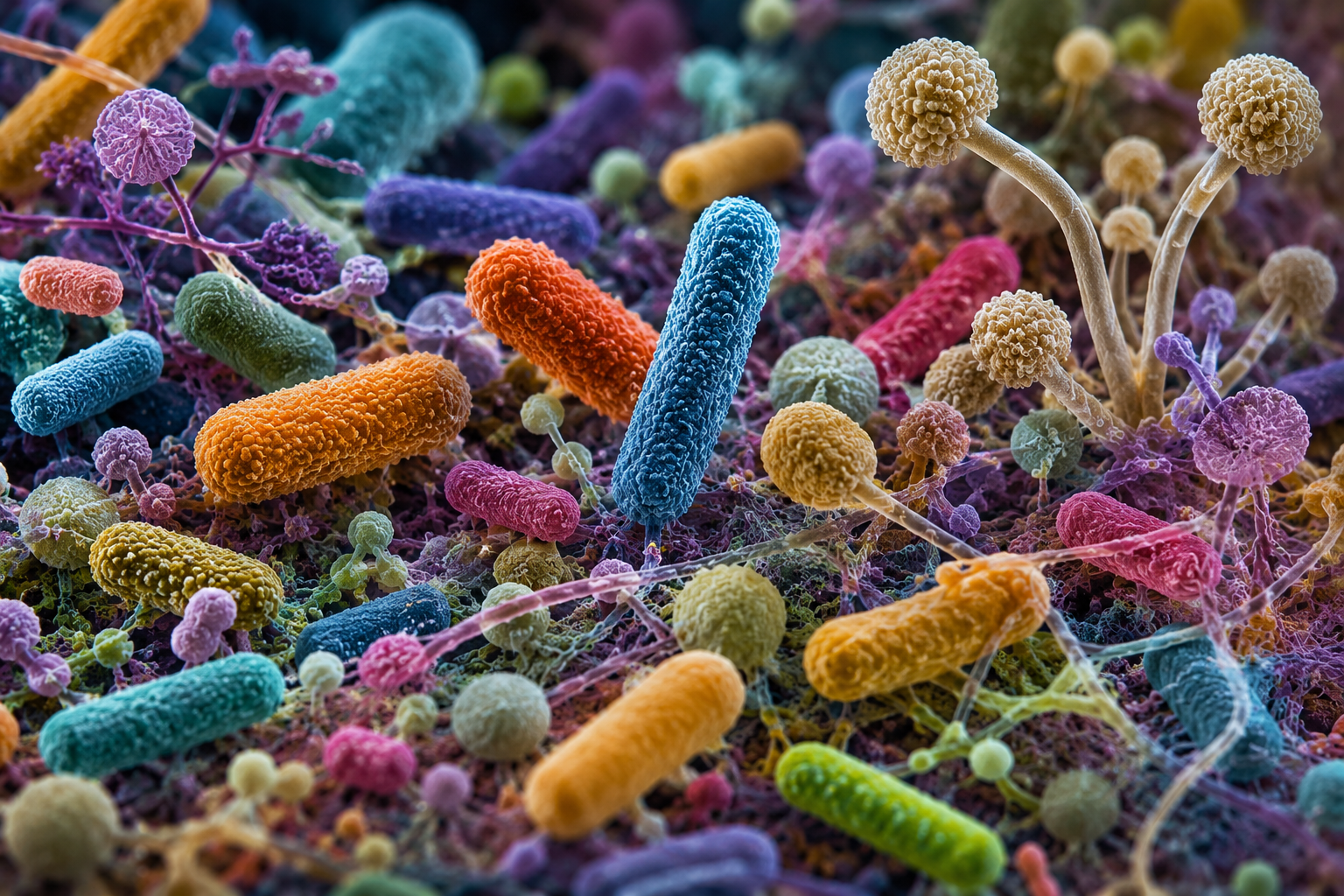
Archaea & mycorrhizae
partners that extend the root zone
32,000+ strains
of beneficial microbes inoculate the soil
Carbohydrate complex
food that feeds soil biology
Organic acids
intermediate chelators for nutrient uptake
PRODUCT IN FOCUS
Balance-D
EcoTech's core microbial technology, built to restore beneficial biology to turf and ornamental root zones. Choose the format that fits your program.
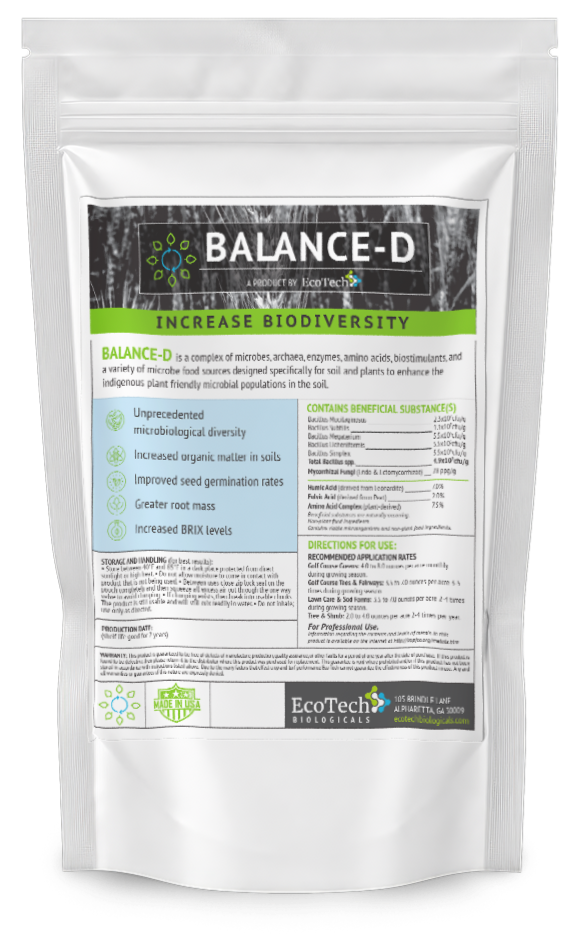
16 oz pouch
Soluble Powder
Greens
4–8 oz/acre, monthly
Tees & fairways
3.5–7 oz/acre, 3–5× per season
Lawn care & sod
3.5–7 oz/acre, 2–4× per season
Tree & shrub
2–4 oz/acre, 2–4× per year
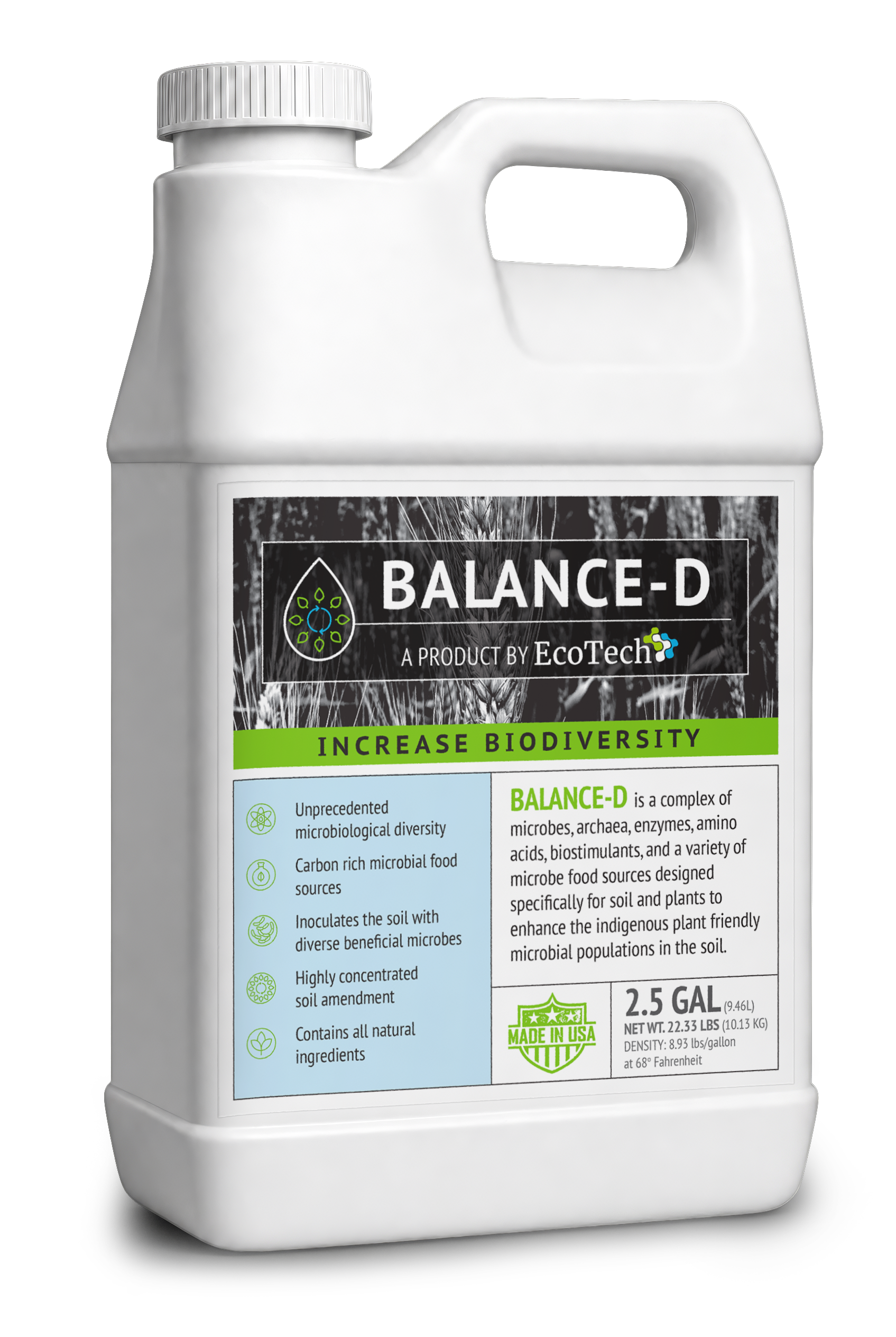
2.5 gal jug
Liquid
Greens
32–64 oz/acre, monthly
Tees & fairways
32–64 oz/acre, 3–5× per season
Lawn care & sod
32–64 oz/acre, 2–4× per season
Tree & shrub
32 oz per 50 gal water
REP'S CORNER
Questions your customers are asking
“I already fertilize. Why do I need biology?”
Fertilizer supplies nutrients. Biology determines how much of them the plant can use. It makes the fertilizer program work harder.
“Do I have to change my whole program?”
No. Add biology to what you already do, starting on the areas that give you the most trouble. Once the biology is established, many programs find they can trim fertilizer rates gradually without giving up quality.
“How fast will I see results?”
Biology builds over weeks, not days. Set expectations for a season: better rooting, recovery and color hold, not an overnight green-up.
See what biology can do on your property
Talk to your EcoTech distributor about a trial area, or reach out to our team directly.
THE NEXT DIRT / ENERGY & ATP